

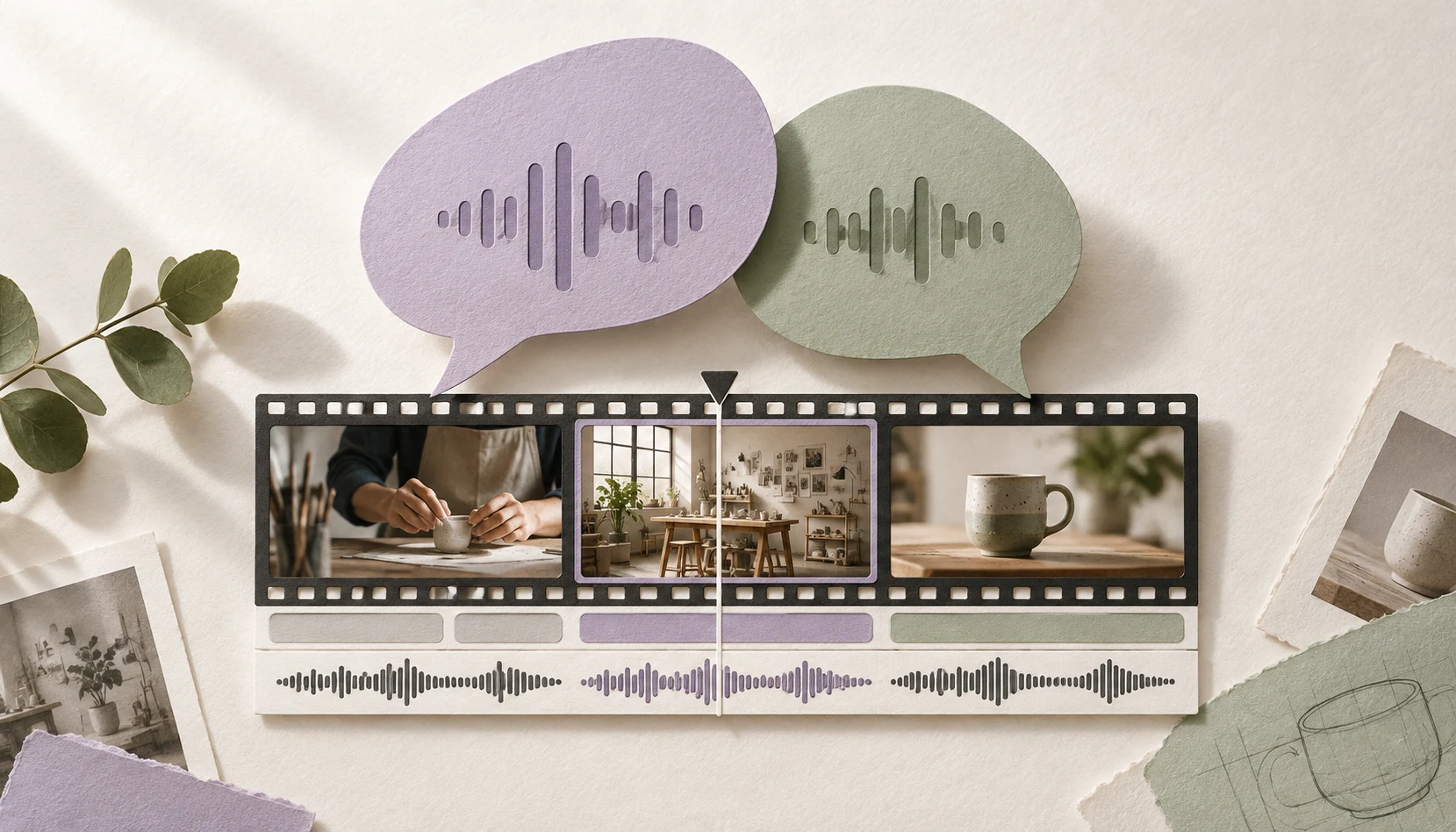
One sentence can describe three very different products
Text-to-video creates footage that did not exist. Auto-cut products usually assemble material through templates, beats, or predefined rules. AI video editing works with media and a project you already have: understanding, selecting, and changing it.
All three may begin with a prompt box and use the word “generate,” which makes them easy to confuse. But generating a new shot does not solve the problem of preserving a real interview answer, finding one moment across hours of travel footage, or continuing an existing timeline.
A useful way to tell them apart is to inspect the deliverable: a newly generated media file, a template-driven finished export, or an editable project containing source references, clip ranges, captions, audio, and tracks.
THE SHORT ANSWERThe value of AI video editing is not locking an answer. It is moving a project faster to the decisions that need your judgment.
Useful AI editing begins by understanding existing footage
Traditional editing software presents media to a person, who watches, remembers, and decides what is usable. For an AI workflow to participate, it needs to know which files exist, what was said, when an event occurs, and how picture, sound, and timeline state relate.
That understanding cannot stop at one summary for an entire video. Meaning needs to remain attached to ranges: an answer begins at 12:18 and ends at 12:46; a landscape appears before sunset; a burst of applause could carry a transition. The Agent can then cite evidence instead of guessing from a vague label.
Once the media index, transcript, visual clues, and timeline form shared project context, a request such as “keep every complete answer about pricing” becomes executable rather than merely conversational.
Conversation turns creative intent into inspectable operations
Creators usually think in outcomes, not command sequences. “Make the opening faster—show the result before explaining the process” contains several decisions: which shot establishes the result, which setup can be shortened, and how dialogue and B-roll should be reordered.
A good workflow does not secretly change everything at once. It can restate the goal, search for candidates, present a plan, and then call tools for trimming, placement, captions, and tracks. The plan gives a creator a chance to correct direction; the tools give each action an explicit input and result.
Conversation also does not require permanent vagueness. A first turn can describe the story; a later turn can say, “move the second answer 1.5 seconds earlier” or “keep the breath but remove the long pause after the question.” Natural language and timeline precision can converge inside the same project.
The editable timeline is the trust boundary
If AI returns only a one-shot render, a creator cannot easily tell why footage disappeared, where captions came from, or how to change one decision. Generation may be fast, but every correction risks becoming another roll of the dice.
An editable project preserves clip boundaries, track relationships, source media, captions, and audio structure. Review what the Agent changed, undo one operation, replace one shot, or hand the current version to another collaborator. Source files remain untouched.
OriginCut connects conversation, media citations, tool calls, and the timeline for this reason. The Agent’s real output is not the sentence “I finished the edit.” It is a project state that can be played, inspected, and revised.
AI is strongest at search and repeated execution, not final taste
Finding ideas in long interviews, removing obvious pauses, organizing product recordings, syncing captions, making alternate formats, or locating one person and moment across a large library all combine clear goals with repetitive work. They are strong candidates for an Agent.
But the second that carries emotion, the pause that gives a sentence weight, or the moment music should disappear rarely has one correct answer. A semantic model can suggest candidates and tools can perform the edit; a creator still needs to watch and judge the final rhythm.
A more useful question than “Can AI edit the whole video for me?” is whether it can turn hours of searching and organization into a reviewable first version while preserving the ability to change every decision.
Questions, answered
Do I need professional editing experience?
No. Begin with the story, audience, and outcome. Use the timeline to inspect clips, captions, and pace when you want precise control.
How is this different from text-to-video?
Text-to-video mainly creates new visuals. AI video editing focuses on understanding existing media and making inspectable, editable changes to a real project.
Is AI video editing the same as auto-cut?
No. Auto-cut often prioritizes producing a result quickly. AI editing may help create a first version, but the important distinction is that the work remains inside an editable project.
Will an Agent modify my source files?
It should not. A non-destructive workflow changes clip references, ranges, and track structure in the project while keeping source media untouched.
Which decisions should not be fully delegated?
Final choices that depend on subtle emotion, complex narrative, or brand taste still deserve human review. The Agent is better used to prepare candidates and execute repetitive work.